The layer you'll never see again.
Guides · Showers
Two finished showers can look identical on the day the glass goes in. Ten years later, one is still tight and the other is growing a stain on the ceiling below. The difference was decided before the first tile was set.
Tile is not the waterproofing
The most useful thing a homeowner can learn about showers: tile and grout are armor, not a raincoat. Grout is cement — it absorbs water. Porcelain sheds most of what hits it, but every joint, corner and screw hole lets some moisture through. A shower stays dry because of a layer you will never see again after tile day. The only question that matters is what that layer is, and who put it there.
There are two honest ways to build it.
The painted way: liquid membranes
Liquid waterproofing — RedGard and its cousins — is rolled or brushed on like thick paint and cures into a rubbery skin. Applied well, it is a legitimate system, and it sits behind plenty of sound showers.
Its weaknesses are human ones. The final thickness depends on the hand holding the roller and the hurry that day. It needs multiple coats with cure time between them, on a schedule nobody can check afterward. And once tile covers it, there is no way to inspect what was actually achieved — thin spots and missed corners disappear from view until they announce themselves through the ceiling below.
The sheet way: Schluter-KERDI
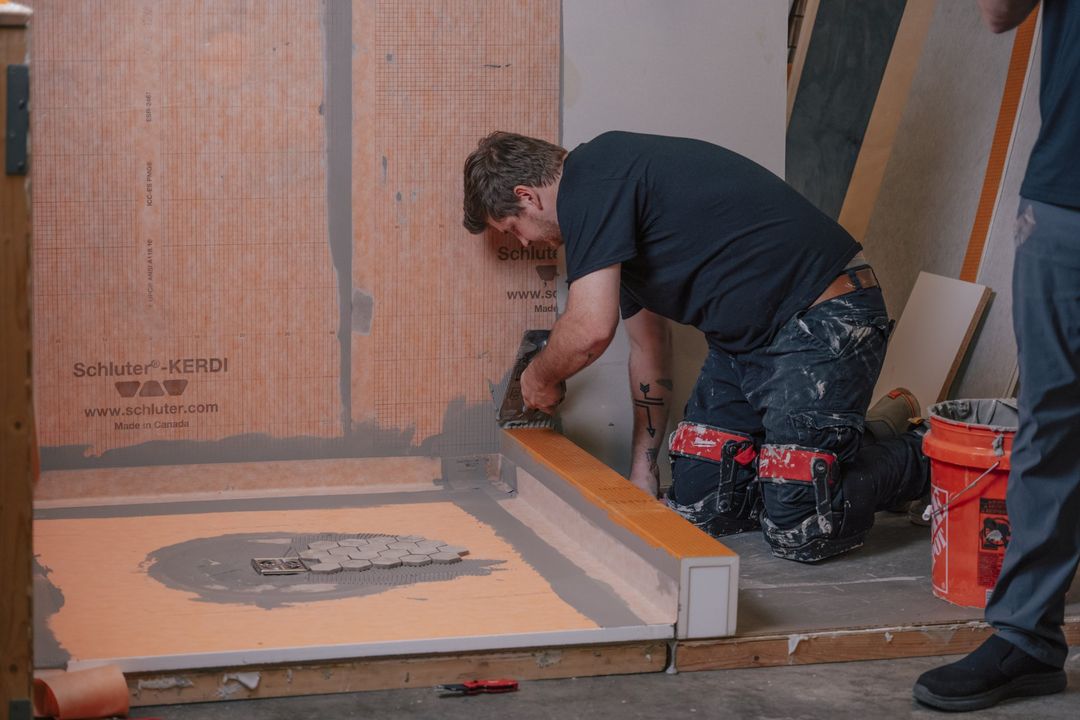
KERDI is the bright orange sheet in the photo. It arrives from the factory at one uniform thickness, every square inch identical, and it is set into thinset across the walls and pan, seams overlapped and sealed, corners built from preformed pieces rather than hope.
Two properties matter. It is vapor-tight, not just water-resistant, so steam cannot slowly load the wall behind it. And the whole assembly can be inspected: before a single tile goes on, you can see every inch of coverage, and the pan can be flood-tested overnight and proven.
Why we set KERDI
We are Schluter certified, and we build the whole wet assembly — pan, curb, drain, niche, membrane — as one system from one manufacturer. That is not brand loyalty; it is accountability. When every layer comes from the same system and the same crew, there is no seam between products for responsibility to fall through.
The honest caveat
A careful liquid job beats a careless sheet job. The membrane does not set itself; the installer is still the product. So whatever crew you talk to — including us — ask four questions:
- What goes behind the tile in the wet areas?
- How are the seams and corners handled?
- Do you flood-test the pan before tiling?
- Will you photograph the waterproofing before it disappears?
A good installer answers all four without blinking. A bad one changes the subject to the tile.
Questions we hear
Does KERDI make the project more expensive?
The sheet costs more than a bucket, but spread across a whole shower the difference is small next to tile and labor — and invisible next to the cost of opening a failed shower back up.
How do I know what my current shower has behind it?
Without opening the wall, you usually cannot. What you can read are the symptoms: grout that keeps cracking at the bottom of the walls, tiles that sound loose down low, a musty smell that cleaning does not fix, or a shadow on the ceiling underneath. Any of those deserves a look before it deserves a remodel.
Do niches and benches need waterproofing too?
Every inch of them. Horizontal surfaces hold water longer than walls do, which makes benches and niche shelves the first places a shortcut shows up.
What is a flood test?
The drain is plugged, the pan is filled, the water line is marked, and it sits overnight. If the line has not moved by morning, the pan is proven before it is ever covered. It costs a day and settles the question for a decade.
Planning a shower? Ask us to walk you through what will go behind your tile — before anything is demolished. The estimate is free and the answers are specific.
Get a free estimateor call 678-983-4615